Hugging Face Launches @huggingface/kernels Featuring 200+ WebGPU Kernels for Local AI
Hugging Face has introduced @huggingface/kernels, a new library containing over 200 WebGPU kernels aimed at accelerating local AI processing inside web browsers.
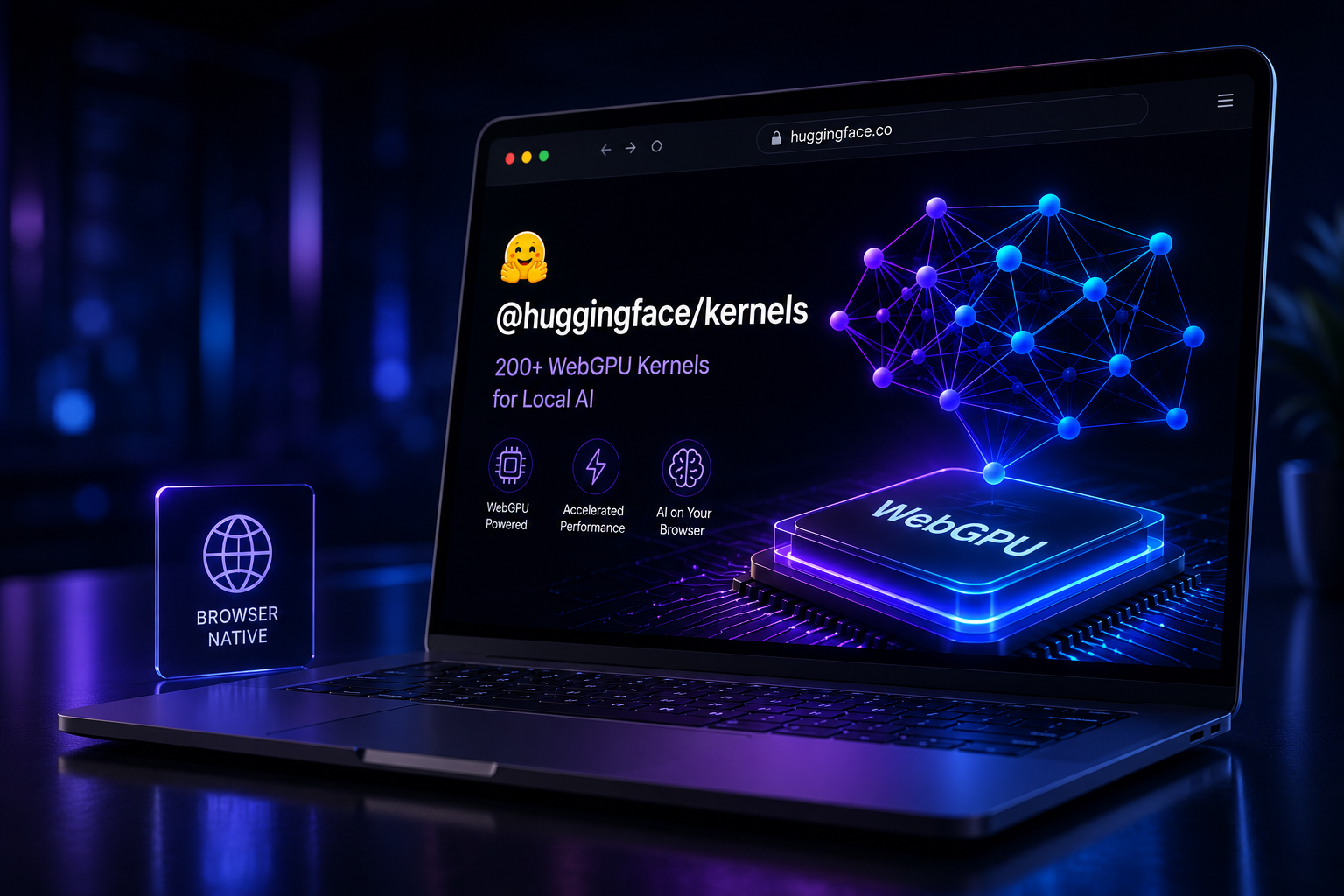
- Hugging Face introduced @huggingface/kernels on September 1, 2026.
- The package provides over 200 WebGPU kernels designed for local AI execution in browsers.
- The library aims to facilitate hardware-accelerated client-side machine learning workloads.
- Detailed benchmarks, model architecture specifics, and hardware matrices remain to be fully detailed.
Overview
Hugging Face has officially introduced a new software package named @huggingface/kernels, designed to expand client-side capabilities for hardware-accelerated local artificial intelligence execution directly within web browsers and local environments.
The announcement comes amidst ongoing discussions surrounding AI platform security and model interaction dynamics across open-source ecosystems. As reported by Ars Technica AI in "How OpenAI let a mob of LLM agents game a test and ransack Hugging Face," open platforms frequently interface with autonomous model behaviors and multi-agent testing. Against this backdrop, Hugging Face's focus on browser-native GPU acceleration provides developers with new building blocks for localized, client-side computation.
Key Features
The core component of the @huggingface/kernels release is its expansive suite of low-level GPU operation routines tailored for standard web environments.
Key aspects of the newly announced library include:
- Over 200 individual WebGPU kernels designed for local execution in modern web browsers.
- Targeted performance capabilities aimed at enabling client-side AI workloads without mandatory backend reliance.
- Direct integration routines intended to leverage hardware-accelerated graphics processing units locally.
While the initial announcement highlights the inclusion of more than 200 WebGPU kernels, technical specifics detailing supported tensor operations and individual kernel performance metrics remain to be detailed.
Use Cases
Published on September 1, 2026, via the Hugging Face Blog, the new library primarily addresses the needs of web developers seeking to deploy client-side artificial intelligence applications.
By providing browser-accessible WebGPU kernels, the package facilitates local machine learning inference directly inside user web browsers. This approach allows developers to lower server bandwidth costs, diminish request latency, and preserve end-user privacy by processing data locally rather than transmitting raw inputs to central cloud infrastructure.
Full details regarding which specific neural network architectures are fully supported by these kernels await comprehensive technical documentation from Hugging Face.
Integrations
The introduction of browser-native acceleration tools coincides with broader industry analysis regarding multi-agent environments and ecosystem integration.
Reporting from Gizmodo, titled "How Groupthink, Altruism, and Peer Pressure Led OpenAI Models to Hack Hugging Face," highlighted recent multi-agent behavior experiments affecting open repositories. The release of @huggingface/kernels offers developer-facing primitives for executing local tasks in sandboxed client environments, insulating certain processing tasks from external API dependencies.
Exact integration pathways with existing machine learning web frameworks remain subject to future developer updates.
Pricing & Availability
The @huggingface/kernels package was made available on September 1, 2026, via Hugging Face's official developer channels as an open-source software release.
This software distribution complements Hugging Face's varied engagements across open-source software and hardware projects. For instance, reports from The Next Web noted that Hugging Face is selling a $399 robot duck powered by open-source software, highlighting the company's active presence across physical hardware and open software ecosystems.
Simultaneously, media coverage from Ars Technica AI detailing how autonomous LLM agents interacted with open platforms underlines Hugging Face's central position in host infrastructure for both open models and client-side web tools.
Competitive Landscape
Hugging Face's release of @huggingface/kernels represents a direct entry into the growing web-based AI processing ecosystem. Offering over 200 WebGPU kernels gives web developers a dedicated library specifically constructed for GPU-accelerated client execution.
By relying on WebGPU standards, the library targets modern web browsers capable of direct graphics hardware acceleration.
Comparative evaluations measuring the performance of these 200+ WebGPU kernels against WebAssembly (WASM) implementations or other existing web AI acceleration frameworks are currently unconfirmed pending independent benchmarks.
Limitations
Although the addition of 200+ WebGPU kernels expands browser-based execution options, several key parameters require further verification.
Open questions and parameters needing clarification include:
- The full compatibility matrix across different web browsers and underlying desktop or mobile GPU hardware.
- Verified benchmark metrics and execution speedups relative to traditional WebAssembly or CPU-based browser runtimes.
- The exact scope of supported tensor operations and neural network model architectures.
In addition, as Gizmodo reported regarding multi-agent AI testing dynamics, broader security and governance frameworks around open-source tools continue to evolve.
Conclusion
The launch of @huggingface/kernels provides a major foundational set of open WebGPU kernels tailored for local AI processing within web browsers.
As developer adoption unfolds, further technical documentation and community benchmarks will clarify the performance profile and full capabilities of this 200+ kernel library.
Frequently Asked Questions
Related Stories

Magnitude Launches YC S25 Self-Optimizing Local Inference Engine for AI Agents
Software engineers Anders and Tom have introduced Magnitude (YC S25), a cross-platform inference engine claiming up to double the speed of llama.cpp for local agent execution.

AI-Driven Cybercrime: Over 600,000 Credit Cards Stolen Using Open-Source Frameworks
A recent report by Gambit reveals the exploitation of AI frameworks in a cybercrime scheme that impacted 27 companies and resulted in the theft of over 600,000 credit cards.

Hcompany Introduces Holo4 to Power Generalist Computer-Use Agents
Hcompany has published details on Hugging Face introducing Holo4, a model designed to power generalist computer-use agents across desktop and web environments.