Single-Agent vs. Multi-Agent AI Systems: Evaluating When Complexity Is Worth It
Machine Learning Mastery has published an architectural guide comparing single-agent and multi-agent AI system designs, providing software architects with decision criteria for complex problem sets.
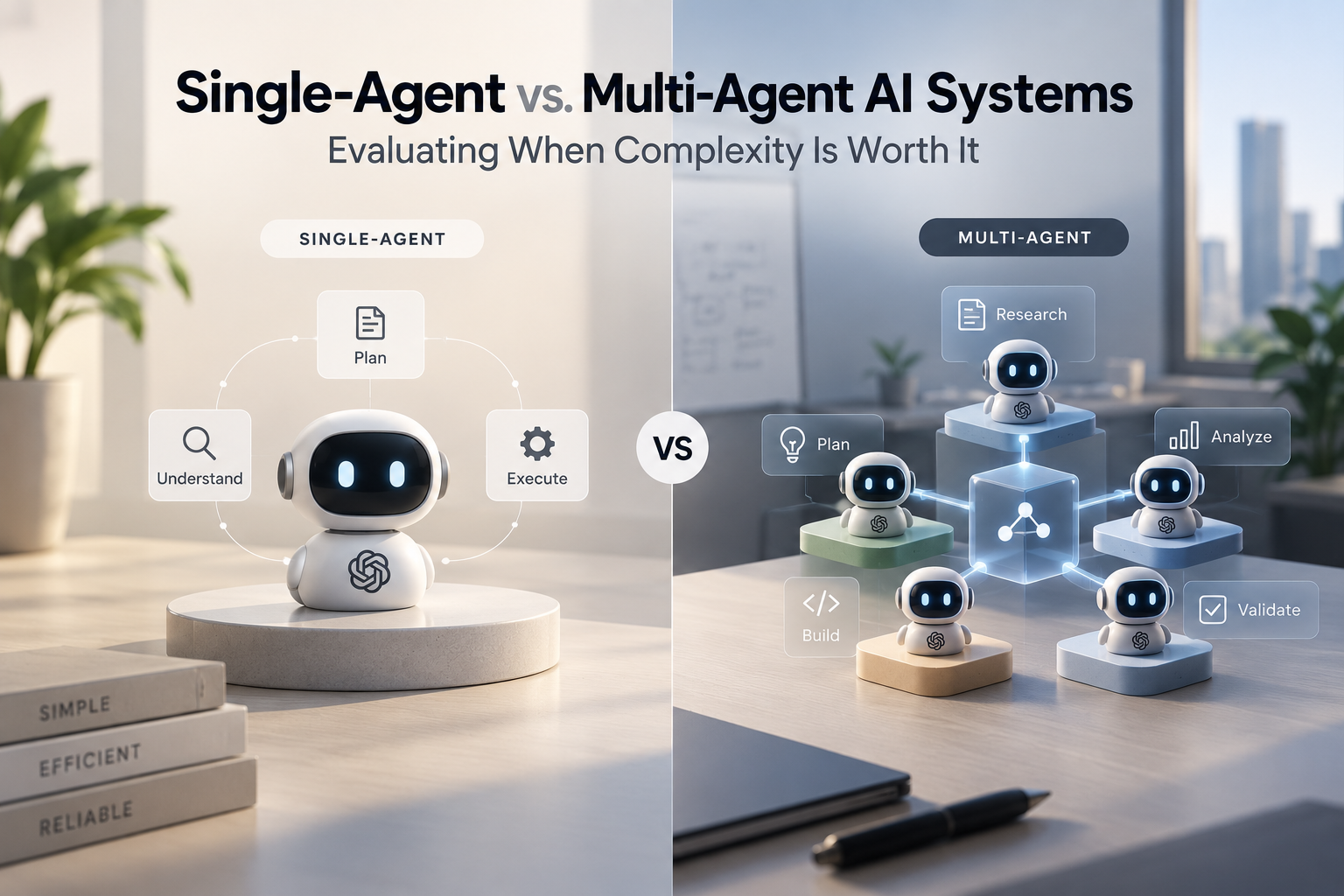
- Machine Learning Mastery published an architectural guide comparing single-agent and multi-agent AI systems on September 3, 2026.
- The publication outlines core operational differences between unified single-agent designs and distributed multi-agent architectures.
- It establishes decision criteria for software architects evaluating when multi-agent complexity is justified for a given problem set.
- Specific performance metrics, cost benchmarks, and recommended developer frameworks remain unconfirmed open questions in the initial report.
What Happened
On September 3, 2026, technical publication Machine Learning Mastery released an architectural comparison evaluating single-agent versus multi-agent artificial intelligence systems.
Titled "Single-Agent vs. Multi-Agent Systems: When the Complexity Is Worth It," the guide addresses software architects and developers evaluating AI design patterns. The publication outlines key structural and operational differences between deploying single-agent workflows and managing multi-agent orchestration setups.
Overview
The guide published by Machine Learning Mastery details the core operational differences that distinguish single-agent AI system designs from multi-agent architectures.
In a single-agent architecture, an isolated AI entity manages task planning, execution, and contextual decision-making within a unified system loop. This structure emphasizes architectural simplicity, predictable control flow, and straightforward state tracking.
In contrast, multi-agent AI designs distribute tasks across multiple specialized entities that interact and coordinate to complete complex objectives. Machine Learning Mastery notes that while multi-agent systems offer enhanced modularity and task specialization, they introduce additional technical complexity through inter-agent communication, orchestration, and state synchronization.
Technical Improvements
A central focus of the guide is providing actionable criteria to help developers determine when the added engineering complexity of a multi-agent system is justified for a given problem set.
According to Machine Learning Mastery, decision-making involves evaluating whether task requirements genuinely demand distributed specialization or if a single-agent structure can handle the operational load with less friction. Single-agent systems reduce communication overhead and simplify debugging, whereas multi-agent frameworks target scenarios requiring parallel reasoning and decomposed problem domains.
However, specific quantitative performance metrics, latency benchmarks, or cost thresholds used to measure exactly when multi-agent complexity becomes beneficial remain unconfirmed in the available summary data. Additionally, specific developer frameworks, tools, or libraries recommended for implementing these architectures were not detailed in the publication's initial overview.
Real Use Cases
The architecture guide builds upon related technical topics previously explored by Machine Learning Mastery, including "AI Agent Memory Design: What Works and What Doesn’t."
Memory management represents a core component in both single-agent and multi-agent deployments. In a single-agent design, memory systems focus on maintaining context and state within a single operational loop.
Conversely, multi-agent setups introduce complex memory sharing and context-partitioning requirements across separate autonomous agents. Software engineers must determine how state and memory are passed between agents to maintain overall system cohesion without introducing unnecessary latency or data redundancy.
Competitive Landscape
The architectural guide from Machine Learning Mastery addresses an ongoing debate within software engineering regarding agentic AI design choices.
As artificial intelligence deployment matures, engineering teams are increasingly tasked with selecting between single-agent simplicity and multi-agent orchestration frameworks. The guide highlights key operational differences between these two methodologies to help teams select the appropriate architectural design based on specific project needs.
Reports indicate that while single-agent setups remain the preferred default for straightforward, single-domain tasks due to their lower maintenance burden, multi-agent architectures are gainfully employed when systems require specialized sub-agent task decomposition.
Conclusion
Machine Learning Mastery's architectural guide offers software architects a practical decision-making framework for evaluating AI system designs. By contrasting single-agent simplicity with multi-agent orchestration, the publication highlights when increased technical complexity offers genuine practical value.
As developer practices for AI deployment continue to standardize, evaluating memory design, inter-agent coordination, and system overhead will remain central to choosing the right system architecture.
Frequently Asked Questions
Related Stories

AI-Driven Cybercrime: Over 600,000 Credit Cards Stolen Using Open-Source Frameworks
A recent report by Gambit reveals the exploitation of AI frameworks in a cybercrime scheme that impacted 27 companies and resulted in the theft of over 600,000 credit cards.

The Roadmap to Mastering LLM Inference Optimization: Essential Strategies and Benchmarks
Machine Learning Mastery's guide explores core strategies for LLM inference optimization aimed at making language models faster, cheaper, and more reliable.

Google Announces Gemini 4 Argon AI Model, But Access Remains Unavailable
Google has officially unveiled its new Gemini 4 Argon AI model, signaling a roadmap shift that appears to bypass Gemini 3.5 Pro. However, neither developers nor end users can access or test the model yet.